Businesses evaluating their cybersecurity often encounter these two terms used almost interchangeably, when in reality they answer fundamentally different questions.
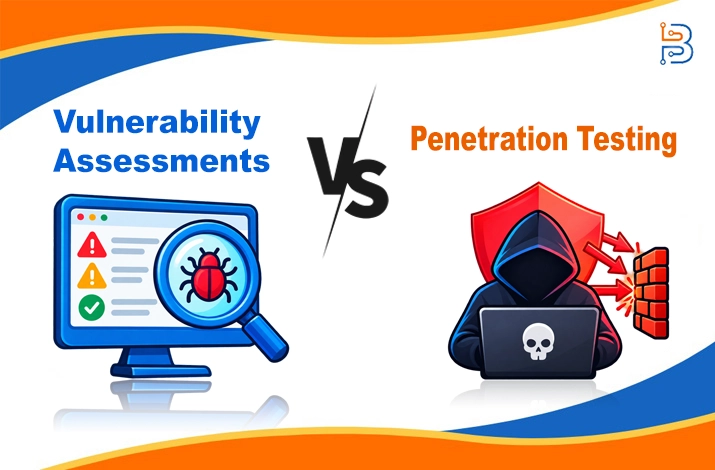
A vulnerability assessment identifies what weaknesses exist. A penetration test determines what an attacker could actually do with them.
Understanding this distinction helps businesses choose the right service for what they actually need to know, rather than assuming one automatically substitutes for the other.
What a Vulnerability Assessment Actually Does
A vulnerability assessment is a systematic scan of a business’s systems, networks, and applications to identify known security weaknesses.
This typically uses automated tools that check for outdated software, missing patches, misconfigurations, and other documented vulnerabilities that match a database of known issues.
The assessment generally produces a comprehensive list of identified weaknesses and ranks them by severity based on the potential risk each vulnerability poses.
Businesses can run this process frequently and quickly to gain broad coverage across their entire environment. It answers the question of what weaknesses exist, giving businesses a foundational understanding of where their technical gaps are located.
What a Penetration Test Actually Does
A penetration test goes further by having a skilled professional actively attempt to exploit identified weaknesses, the same way a real attacker would, to determine what access or damage those weaknesses would actually allow.
Rather than simply flagging a vulnerability, a penetration test demonstrates whether an attacker can genuinely exploit it to gain unauthorized access and how far they can extend that access.
Penetration testing requires more time and specialized expertise, so businesses generally conduct it less frequently than vulnerability scans, often annually or after significant system changes. It answers a different question: not just what weaknesses exist, but how exploitable and dangerous they actually are in combination.
Why the Distinction Between These Two Matters
A vulnerability assessment might identify twenty different weaknesses across a business’s systems, each individually rated as low to moderate severity.
A penetration test might reveal that three of those seemingly minor weaknesses, when combined in a specific sequence, actually allow an attacker to gain full administrative access to the network. A penetration test specifically uncovers this kind of combined risk, while a standard vulnerability scan generally cannot detect it.
This is why relying solely on vulnerability assessments can create a false sense of security. A business might see a list of moderate-severity findings and reasonably conclude that its overall risk is manageable, without realizing that an attacker could chain those findings together to create a far more serious threat than any individual weakness suggests.
When a Vulnerability Assessment Is the Right Tool
Vulnerability assessments are well suited for regular, ongoing monitoring, since they can be run frequently and provide broad visibility into a business’s overall security posture without requiring the time and cost of a full penetration test each time.
Many businesses run vulnerability assessments monthly or quarterly as a baseline practice, using the results to guide routine patching and configuration improvements.
This makes vulnerability assessments a practical foundation for maintaining ongoing security hygiene, catching newly introduced weaknesses relatively quickly as systems and software change over time.
When a Penetration Test Is the Right Tool
Penetration testing is better suited for a deeper, periodic evaluation of how a business’s overall security would hold up against a genuinely determined attacker, and for satisfying compliance requirements that specifically call for this kind of testing rather than a vulnerability scan alone.
Businesses considering a significant change, such as a new application deployment or a major infrastructure shift, also benefit from a penetration test focused on the new components specifically, since these changes often introduce risk that a routine vulnerability scan alone would not fully capture.
Why Most Businesses Benefit from Using Both
Rather than choosing one over the other, most businesses get the strongest security posture by using vulnerability assessments for frequent, ongoing monitoring and penetration testing for periodic, deeper evaluation.
The vulnerability assessment catches and helps address issues quickly and regularly, while the penetration test periodically confirms whether the accumulated defenses actually hold up against a genuine attempt to break in.
Businesses that rely exclusively on one or the other typically end up with an incomplete picture, either missing the combined risk that only active exploitation testing reveals, or lacking the frequent, broad monitoring that keeps day-to-day security hygiene on track between periodic deeper assessments.
How Mindcore Technologies Helps Businesses Use Both Effectively
Mindcore Technologies has spent more than 30 years helping businesses build security programs that combine regular vulnerability assessments with periodic penetration testing to get a complete, accurate picture of their actual risk.
Under the leadership of Matt Rosenthal, CEO of Mindcore Technologies, the company delivers AI-powered IT and cybersecurity solutions that include both services, along with the prioritized remediation support needed to close what each one uncovers.
Businesses working with Mindcore get a security program that combines the frequent visibility of vulnerability assessments with the deeper, real-world validation that only penetration testing provides.
Conclusion
Vulnerability assessments and penetration testing are complementary tools, not interchangeable ones. A vulnerability assessment identifies what weaknesses exist across a business’s environment, while a penetration test demonstrates what an attacker could actually accomplish by exploiting them.
Businesses that understand this distinction and use both tools for the purposes they are actually suited to build a far more accurate and complete picture of their real security posture than relying on either one alone.
About the Author
Matt Rosenthal is the CEO and President of Mindcore Technologies, a full-service IT consulting and cybersecurity firm serving businesses across Florida, New Jersey, Maryland, South Carolina, Louisiana, Texas, and nationwide.
With more than 30 years of experience in IT leadership, managed services, and technology strategy, Matt has helped organizations across healthcare, financial services, and professional services build security programs that combine ongoing monitoring with periodic, in-depth testing.
He holds an MBA in Technology Management, is a certified Project Management Professional (PMP), and is the host of Digging In, a weekly podcast on success in business, life, and health.