Every shortcut below is taken from Apple’s macOS 27 Mac User Guide and its “Take a screenshot on Mac” support article, re-read on November 3, 2026. There are no affiliate links, and no images of the macOS interface, because we would rather describe it accurately than mock it up.
Quick answer
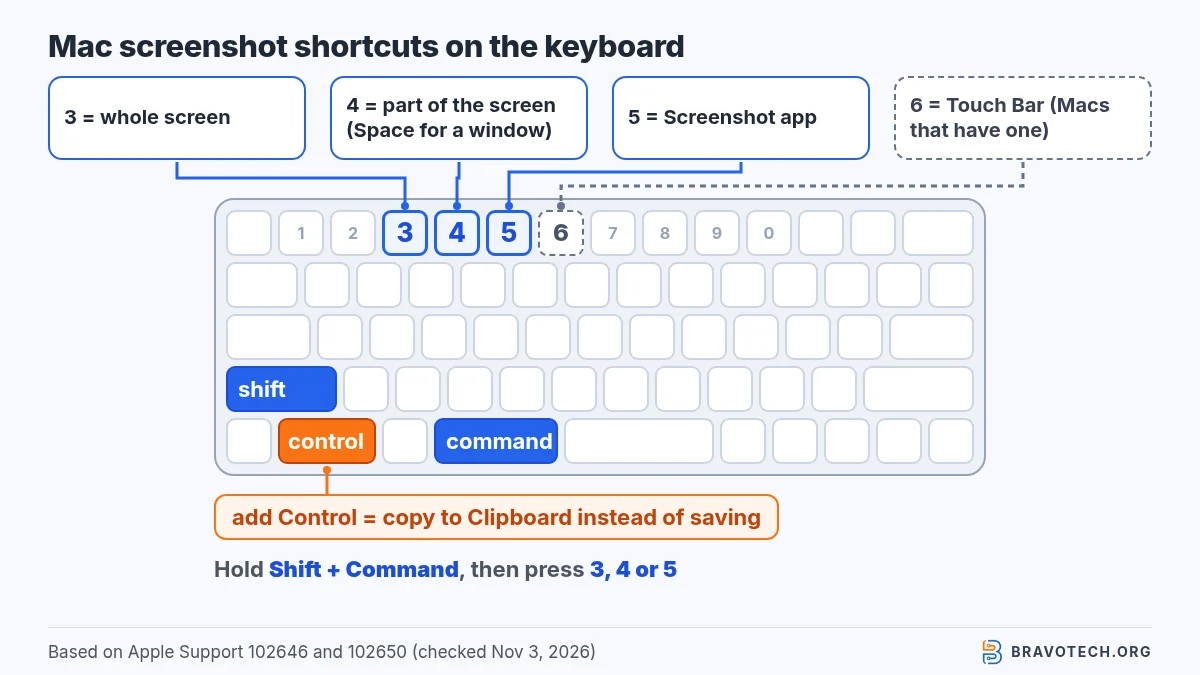
Press Shift-Command-3 to screenshot the whole screen on a Mac. Use Shift-Command-4 and drag to grab part of the screen, or press Shift-Command-4 then the Space bar and click a window. Shift-Command-5 opens the Screenshot app with a timer and save options. Add Control to any shortcut to copy instead of save. Files land on the desktop by default.
Key takeaways
- Three shortcuts cover almost everything: 3 for the full screen, 4 for an area, 4 + Space for one window or menu.
- Hold Control to skip the file. The screenshot goes to the Clipboard, ready to paste with Command-V.
- Missing screenshot? It’s on the desktop unless you changed Save to in the Screenshot app’s Options menu.
- Same keys on every Mac. Apple’s instructions don’t change between MacBook Air, MacBook Pro, iMac or Mac mini.
- Windows keyboard: Apple says the Windows logo key or Ctrl stands in for Command, and Alt for Option.
What is the keyboard shortcut to take a screenshot on a Mac?
The main Mac screenshot shortcut is Shift-Command-3, which captures the entire screen. Press the three keys together and release them. Shift-Command-4 captures an area you drag, and Shift-Command-5 opens the Screenshot app. All of these save a file to your desktop unless you add the Control key, which copies the screenshot to the Clipboard instead (Apple Support).
The table puts every screenshot shortcut Apple documents in one place, with the Clipboard version next to it. The Windows-keyboard column applies Apple’s key mapping from its Mac keyboard shortcuts page; it’s our translation, not a table Apple publishes.
| To capture | Save to file | Copy to Clipboard instead | On a Windows keyboard (save) |
|---|---|---|---|
| Entire screen | Shift-Command-3 | Control-Shift-Command-3 | Shift + Windows logo key (or Ctrl) + 3 |
| Part of the screen (drag) | Shift-Command-4, drag | Control-Shift-Command-4, drag | Shift + Windows logo key (or Ctrl) + 4 |
| A window or the menu bar | Shift-Command-4, then Space, click | Hold Control with the keys, then Space, click | Shift + Windows logo key (or Ctrl) + 4, then Space |
| Menu items | Open the menu, Shift-Command-4, drag over the items | Add Control to the keys | Shift + Windows logo key (or Ctrl) + 4 |
| Open the Screenshot app | Shift-Command-5 | Control-click the thumbnail > Save to Clipboard | Shift + Windows logo key (or Ctrl) + 5 |
| Touch Bar (Macs that have one) | Shift-Command-6 | Control-Shift-Command-6 | Not applicable |
How do you screenshot the whole screen on a Mac?
Press and release Shift, Command and 3 together to capture everything on the screen. A thumbnail may appear in the bottom-right corner for a few seconds. Click it to edit the screenshot, or leave it and the file saves to your desktop on its own. Hold the pointer over the thumbnail and it stays put until you act on it or move away (Apple Support).
How do you screenshot part of the screen on a Mac?
Press Shift-Command-4, then drag the crosshair over the area you want. Release the mouse or trackpad button to take the shot. Press Esc to cancel before you release. To move the selection without changing its size, hold the Space bar while you drag. This is the shortcut most people mean by “snipping” on a Mac, and it’s the one to use for a crop-as-you-go screenshot (Apple Support).
- Press Shift-Command-4. The pointer turns into a crosshair.
- Click and hold, then drag over the part of the screen you want.
- Hold the Space bar while dragging if you need to move the box; let go of Space to resize again.
- Release the button to capture, or press Esc to cancel.
How do you screenshot just one window or menu?
Press Shift-Command-4, then tap the Space bar, and click the window or menu. The pointer becomes a camera icon and highlights whatever it’s over. Click to capture only that item. Hold the Option key while you click if you don’t want the window’s shadow in the image. For a menu’s items rather than the whole menu, open the menu first, press Shift-Command-4, and drag over the items (Apple Support, Mac User Guide).
How do you use the Screenshot app (Shift-Command-5)?
Press Shift-Command-5 to open Screenshot, pick a capture tool, then click Capture. The toolbar lets you capture the entire screen, a window or a portion. The Options menu adds a timer, a save location, the floating thumbnail and the mouse pointer. Apple says the app is available in macOS Mojave 10.14 or later, and you can also open it from the Utilities folder inside Applications (Apple Support).
What the Options menu controls, according to the Mac User Guide:
- Save to: a preset location, or Other Location to pick any folder.
- Timer: a delay before the capture starts, handy for screenshots of menus that close when you press keys.
- Show Floating Thumbnail: turn the corner preview on or off.
- Remember Last Selection: reuse the last area you selected.
- Show Mouse Pointer: include or hide the pointer.
- Capture Format: on supported Macs with macOS Tahoe 26 or later, choose SDR (PNG, most compatible) or HDR (HEIF). Apple notes HDR needs an HDR display to see the difference.
The same toolbar also records video. Recording has its own guide: how to screen record on a Mac, including audio.
How do you copy a Mac screenshot to the clipboard instead of saving it?
Add the Control key to any screenshot shortcut, and the image goes to the Clipboard instead of the desktop. For example, Control-Shift-Command-4 copies the area you drag. Then paste it into an email, document or chat with Command-V. If you already took a normal screenshot, Control-click the thumbnail in the corner and choose Save to Clipboard before it disappears (Apple Support).
Where do screenshots go on a Mac?
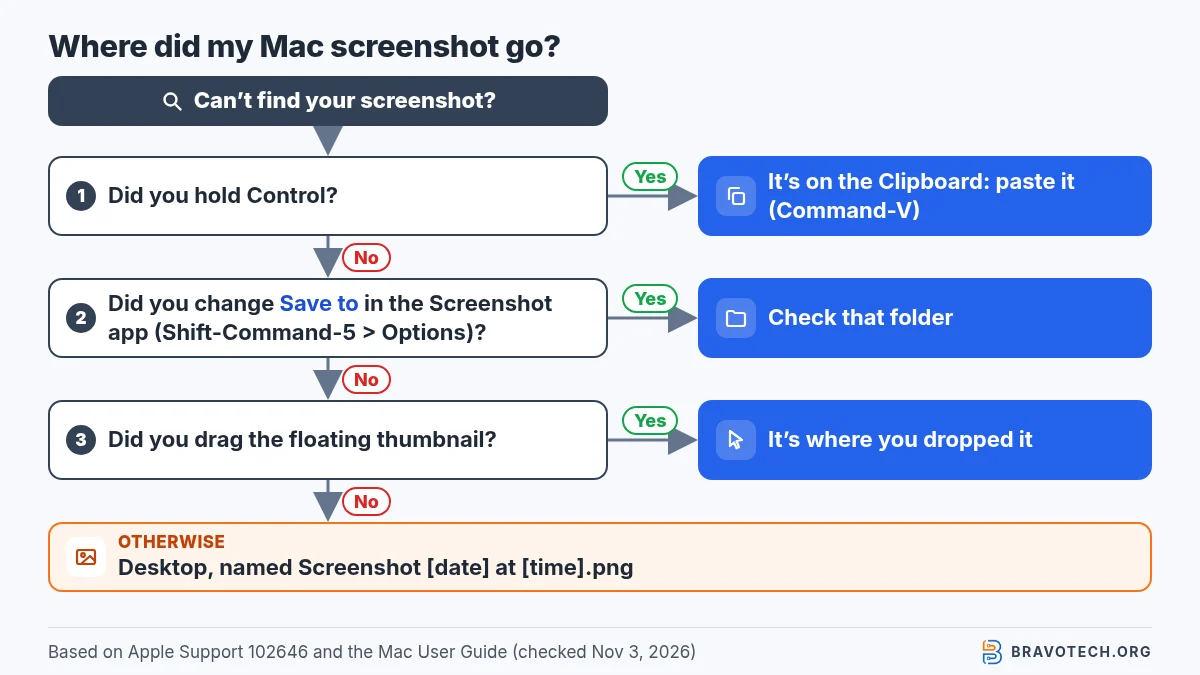
By default, Mac screenshots save to your desktop. Apple’s Mac User Guide says the files are .png and the filenames begin with “Screenshot” followed by the date and time. Older wording in Apple’s support article uses “Screen Shot [date] at [time]”, so either name can appear depending on your macOS version. If you changed the location in the Screenshot app, new files go to that folder instead (Mac User Guide, Apple Support).
If a screenshot isn’t on the desktop, one of these is usually why. Each row follows from how Apple says the shortcuts and the thumbnail behave:
| What you did | Where the screenshot is |
|---|---|
| Used a shortcut with Control | Only on the Clipboard. Paste it with Command-V; there’s no file. |
| Changed Save to in Shift-Command-5 > Options | In that location, for every shortcut, until you change it back. |
| Dragged the thumbnail somewhere | Wherever you dropped it (a document, an email, a Finder folder). |
| Chose Save to Clipboard on the thumbnail | On the Clipboard only. |
| Captured with HDR selected | Saved as an HEIF image rather than PNG, so search by the HEIF format, not .png. |
| Used a shortcut inside the Apple TV app or DVD Player | Possibly nowhere. Apple says some apps may not allow window screenshots. |
How do you change where Mac screenshots are saved?
Open the Screenshot app with Shift-Command-5, click Options, and pick a folder under “Save to”. Choose one of the preset locations, or Other Location to browse to any folder. The setting sticks, so later shortcuts save there too. This is the only method Apple documents for changing the location, and it doesn’t involve Terminal commands (Mac User Guide).
How do you take a screenshot on a Mac with a Windows keyboard?
Use the same shortcuts, swapping Command for the Windows logo key or Ctrl. Apple’s keyboard-shortcuts page says that on keyboards made for Windows PCs, Alt replaces Option, and the Ctrl key or the Windows logo key replaces Command. So Shift + Windows logo key + 3 is usually the full-screen shot. Which of the two keys acts as Command depends on the keyboard (Apple Support).
The Print Screen key isn’t mentioned anywhere in Apple’s screenshot instructions, so don’t count on it. If the Clipboard trick gets confusing on a Windows keyboard (Ctrl may already be standing in for Command), take a normal screenshot and use Save to Clipboard on the thumbnail instead. If you also use a PC, our Windows screenshot guide covers the Windows side.
How do you screenshot on a Mac without a keyboard?
Open the Screenshot app from Finder and click Capture, no key presses needed. Go to Applications, then Utilities, and open Screenshot. Choose the full-screen, window or portion tool, then click Capture (for a window, click the window). Set the Timer option if you need a few seconds to set up the screen. You can also find Screenshot with Spotlight (Apple Support, Mac User Guide).
Is it different on a MacBook Air, MacBook Pro or other Macs?
No. The screenshot shortcuts are part of macOS, so they work the same on any Mac. Apple’s instructions don’t separate MacBook Air, MacBook Pro, MacBook Neo, iMac or Mac mini. Two things can differ: Shift-Command-6 only matters on Macs with a Touch Bar, and the Screenshot app needs macOS Mojave 10.14 or later. To check your version, choose Apple menu > About This Mac (Apple Support, Apple Support).
Why is my Mac screenshot shortcut not working?
Check whether the app blocks screenshots, then check the shortcut settings. Apple says some apps, such as the Apple TV app and DVD Player, may not let you capture their windows. Screenshot shortcuts can also be changed or switched off in System Settings > Keyboard > Keyboard Shortcuts > Screenshots, so a changed setting can make the default keys stop working (Apple Support, Mac User Guide).
Worth knowing
A macOS 27 overlap to know about. Apple’s support article says that with Siri AI (Beta) turned on in macOS 27, Command-Shift-6 asks Siri about a portion of the screen. The Mac User Guide still lists Shift-Command-6 for capturing the Touch Bar. We couldn’t find an Apple note on how the two interact, so if you have a Touch Bar and Siri AI on, check which one you get.
FAQ
How do I crop or mark up a screenshot on a Mac?
Click the floating thumbnail right after you take the screenshot. Apple says this opens a window where you can mark up the screenshot or share it. To avoid cropping later, use Shift-Command-4 and drag only the area you need.
Can I set a timer for a Mac screenshot?
Yes. Press Shift-Command-5, open Options, and choose a delay under Timer. Then click Capture. The timer is useful for menus or hover states that disappear when you press keys.
How do I take a window screenshot without the shadow?
Press Shift-Command-4, press the Space bar, then hold the Option key while you click the window. Apple documents this as the way to leave the shadow out.
Can I turn off the floating thumbnail?
Yes. In the Screenshot app (Shift-Command-5), open Options and clear Show Floating Thumbnail. Screenshots then save straight away. Apple also says the thumbnail stays on screen while your pointer is over it.
Does iPhone or iPad use the same shortcuts?
No. iPhone and iPad use button combinations, not keyboard shortcuts. See our iPad screenshot guide; the iPhone guide is our iPhone screenshot guide. Chromebook owners can use the Chromebook screenshot guide.
How this article was made. We drafted this article with the help of AI tools, working from the official pages listed in Sources. Prices, plan limits and steps were checked against those pages on November 3, 2026. Fawad Malik is the credited author; the BravoTech team prepared it under our editorial standards. We did not test these products hands-on for this article. Spot an error? Email [email protected].
Sources
Apple’s own documentation only, opened and re-read on November 3, 2026 (PKT).
Show all 4 sources
Changelog
- November 3, 2026: First published. Shortcuts, Screenshot app options, save location and the macOS 27 Siri AI note checked against Apple Support 102646, 102650 and the macOS 27 Mac User Guide on November 3, 2026.
Related reads