No affiliate links or sponsorship. This guide follows Apple Support and the iPhone User Guide for iOS 27, checked November 2, 2026. We didn’t change these settings on a physical iPhone for this article, and there are no screenshots; menu names are quoted from Apple.
Quick answer
Go to Settings > Face ID & Passcode (Touch ID & Passcode on iPhone SE and iPhone Duo), enter your passcode, tap Stolen Device Protection and turn it off. At home or another familiar location that’s instant. Anywhere else, or if you picked Always, tap Start Security Delay: Face ID, a one-hour wait, then Face ID again. Most people should leave it on and only switch it off before selling or trading in the phone. More iPhone guides: iPhone hub.
How to turn off Stolen Device Protection
These steps are the same on every iPhone that runs iOS 27, from iPhone 11 and iPhone SE (2nd generation) to the iPhone 18 Pro models and iPhone Duo. Only the menu name changes on Touch ID phones.
- Open Settings.
- Tap Face ID & Passcode. On iPhone SE or iPhone Duo, tap Touch ID & Passcode.
- Enter your passcode.
- Scroll down and tap Stolen Device Protection.
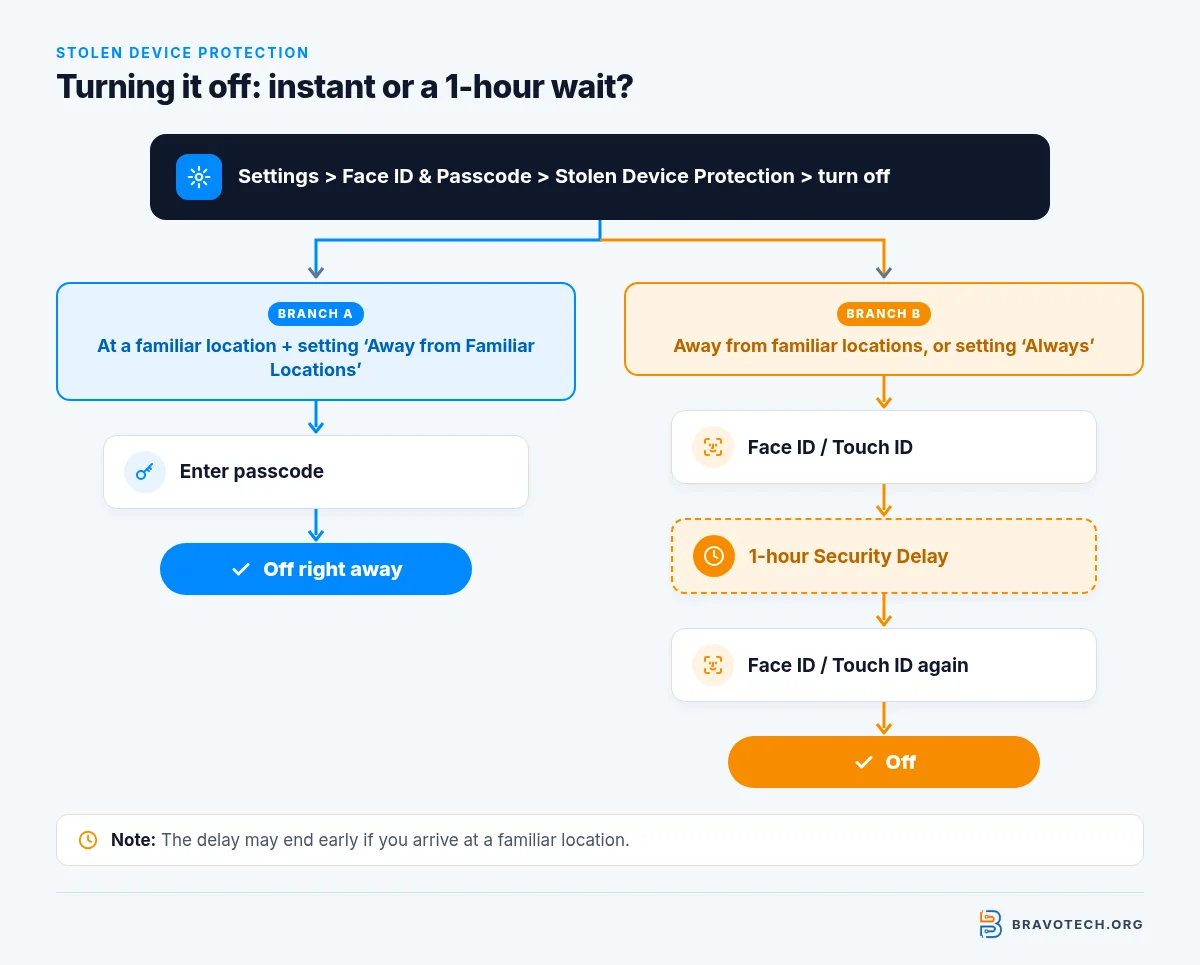
- Turn off Stolen Device Protection. If iOS shows Start Security Delay instead, go to the next section.
If you see Start Security Delay
The Security Delay appears when you try to turn the feature off away from a familiar location, or anywhere if you chose Always under Require Security Delay. Here’s what happens after you tap it:
- Authenticate with Face ID or Touch ID. The passcode isn’t accepted for this step.
- Wait one hour. If you arrive at a familiar location during the hour, Apple says the iPhone may end the delay early.
- Go back to Stolen Device Protection and authenticate with Face ID or Touch ID again. The switch now turns off.
Why the wait exists
Apple designed the hour so that, if a thief has your phone and passcode, you have time to mark the iPhone as lost before anyone can change your Apple Account password or turn protection off. The delay is the feature working, not a bug.
Should I turn off Stolen Device Protection on my iPhone?
What changes when Stolen Device Protection is on
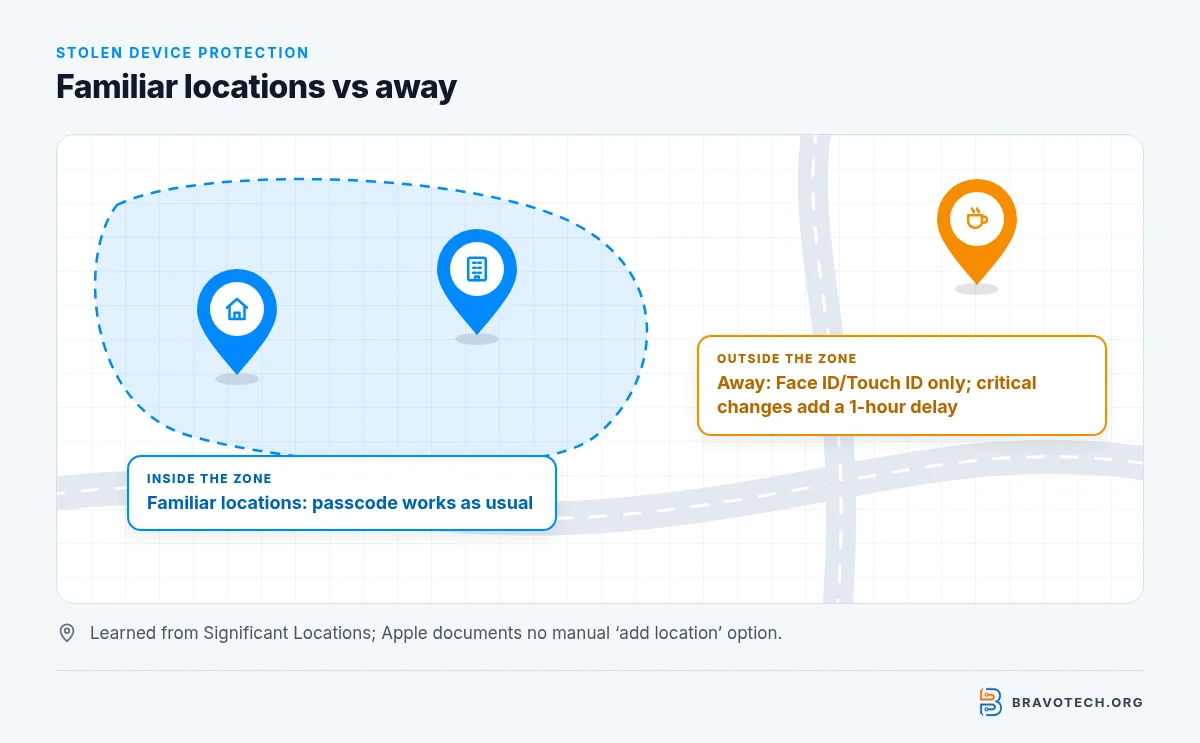
Apple splits protected actions into two groups. Using saved passwords, saved cards, Lost Mode, erasing the iPhone and similar actions need Face ID or Touch ID only. Changing your passcode, your Apple Account password, Face ID itself and a few other critical settings need Face ID, a one-hour wait, then Face ID again. At a familiar location, neither group applies unless you chose Always.
Apple lists these actions on two separate parts of About Stolen Device Protection for iPhone (dated October 22, 2026), and locked apps follow its locked apps note. We put all 18 in one table so you can see what to expect before you try something away from home.
| Action on your iPhone | Away from familiar locations (or setting = Always) | At home, work or another familiar location (default setting) |
|---|---|---|
| Use passwords or passkeys saved in Keychain | Face ID or Touch ID, no passcode | Passcode works as usual |
| Use payment methods saved in Safari AutoFill | Face ID or Touch ID, no passcode | Passcode works as usual |
| Turn off Lost Mode | Face ID or Touch ID, no passcode | Passcode works as usual |
| Open a locked app | Face ID or Touch ID, no passcode | Face ID, Touch ID or passcode |
| Erase All Content and Settings | Face ID or Touch ID, no passcode | Passcode works as usual |
| Apply for a new Apple Card; view Apple Card or Apple Cash virtual card number | Face ID or Touch ID, no passcode | Passcode works as usual |
| Some Apple Cash and Savings actions in Wallet (such as transfers) | Face ID or Touch ID, no passcode | Passcode works as usual |
| Use this iPhone to set up a new device (Quick Start) | Face ID or Touch ID, no passcode | Passcode works as usual |
| Set up or transfer an eSIM | Face ID or Touch ID, no passcode | Passcode works as usual |
| Change your Apple Account password | Face ID + 1-hour Security Delay + Face ID again | Passcode works as usual |
| Sign out of your Apple Account | Face ID + 1-hour Security Delay + Face ID again | Passcode works as usual |
| Change Apple Account security settings (trusted device, Recovery Key, Recovery Contact) | Face ID + 1-hour Security Delay + Face ID again | Passcode works as usual |
| Add or remove Face ID or Touch ID | Face ID + 1-hour Security Delay + Face ID again | Passcode works as usual |
| Change your passcode | Face ID + 1-hour Security Delay + Face ID again | Passcode works as usual |
| Reset All Settings | Face ID + 1-hour Security Delay + Face ID again | Passcode works as usual |
| Enroll in Mobile Device Management (work or school) | Face ID + 1-hour Security Delay + Face ID again | Passcode works as usual |
| Turn off Stolen Device Protection | Face ID + 1-hour Security Delay + Face ID again | Passcode works as usual |
| Pay with Apple Pay | Passcode still allowed | Passcode works as usual |
How to turn it back on or change when it applies
Turning protection on needs two-factor authentication for your Apple Account, a passcode, Face ID or Touch ID, Significant Locations and Find My. While it’s on, you can’t turn off Find My.
- Go to Settings > Face ID & Passcode (or Touch ID & Passcode) and enter your passcode.
- Tap Stolen Device Protection and turn it on.
- Under Require Security Delay, choose Away from Familiar Locations (the default) or Always.
Common questions about Stolen Device Protection
What is Stolen Device Protection on iPhone?
Stolen Device Protection is an iPhone setting that adds checks when your phone is away from familiar places such as home or work. Some actions then need Face ID or Touch ID with no passcode fallback, and critical changes also need a one-hour Security Delay. The goal, per Apple Support, is to stop a thief who has watched you type your passcode from taking over your Apple Account.
Is Stolen Device Protection on by default?
It might be. Apple says the feature “might be turned on by default,” so check before assuming it’s off: go to Settings > Face ID & Passcode, enter your passcode, and look for the Stolen Device Protection switch. It needs iOS 17.3 or later, two-factor authentication, a passcode, Face ID or Touch ID, Significant Locations, and Find My, so it can’t run if one of those is missing.
Can I turn off Stolen Device Protection with just my passcode?
Only in one situation. If your setting is Away from Familiar Locations and your iPhone is at a familiar location, the passcode works like usual and you can switch the feature off right away. Away from those places, or with the Always option chosen, iOS asks for Face ID or Touch ID, starts the one-hour Security Delay, and then asks for Face ID or Touch ID again.
How do I turn off Stolen Device Protection if Face ID isn’t working?
If your setting is Away from Familiar Locations, go somewhere your iPhone already treats as familiar, such as home, where the passcode works as usual. If you chose Always, or you’re traveling, the Security Delay needs Face ID or Touch ID, and Apple doesn’t document a passcode-only way around it. In that case, contact Apple Support about the Face ID problem instead of looking for workarounds.
Why is Stolen Device Protection greyed out or missing?
Usually because a requirement is off. Apple lists two-factor authentication for your Apple Account, a device passcode, Face ID or Touch ID, Significant Locations and Find My, plus iOS 17.3 or later. Turn on Significant Locations in Settings > Privacy & Security > Location Services > System Services > Significant Locations & Routes, then check Settings > Face ID & Passcode again.
Can I turn off Stolen Device Protection remotely or online?
Not that Apple documents. Apple only describes the switch in the iPhone’s own settings, and it says the protected security settings can’t be updated on the web at account.apple.com. You might also have to wait before you can change them on a new device. If the phone is already gone, don’t try to disable the feature: mark it as lost at iCloud.com/find instead, which is what the delay is designed to give you time to do.
What counts as a familiar location, and can I add one?
Apple says familiar locations typically include your home, work and other places where you regularly use your iPhone. They come from Significant Locations, so the iPhone learns them over time; Apple’s documentation doesn’t describe a way to add one by hand. After you restore or transfer to a new iPhone, there may be a delay before it recognizes those places, so expect extra prompts for the first days.
Does Stolen Device Protection exist on iPad or Apple Watch?
Apple documents Stolen Device Protection as an iPhone feature. Its support article is titled “About Stolen Device Protection for iPhone,” and the iPad User Guide’s privacy and security section for iPadOS 27 doesn’t list it. Apple’s pages also don’t describe an Apple Watch version. If you’re searching for the switch on an iPad or watch and can’t find it, that’s expected; the setting is on the iPhone.
Do I need to turn it off before selling or trading in my iPhone?
Yes. Apple says to turn off Stolen Device Protection before you sell, give away or trade in your iPhone, and to do it alongside the rest of the pre-sale checklist: back up, transfer to the new phone, sign out of your Apple Account, then erase. Do it at home so the passcode is enough, or plan for the one-hour Security Delay if you’re elsewhere.
Does the setting carry over to a new iPhone?
Yes. When you restore from an iCloud backup or transfer directly from your old iPhone, your device settings come across, including Stolen Device Protection, and its protections resume on the new phone. Apple notes there may be a delay before the new iPhone recognizes your familiar locations, so you might see Face ID-only prompts or a Security Delay at home for a while.
What should I do first if my iPhone is stolen?
Mark it as lost at iCloud.com/find as soon as you can; you don’t need a verification code to sign in there. Apple says not to remove the device from Find My, because that removes Activation Lock, and not to add contact details if it was stolen. Stolen Device Protection only buys time, so Lost Mode is still the main step. Apple’s stolen iPhone guide lists the rest.
How this article was made. We drafted this article with the help of AI tools, working from the official pages listed in Sources. Prices, plan limits and steps were checked against those pages on November 2, 2026. Fawad Malik is the credited author; the BravoTech team prepared it under our editorial standards. We did not test these products hands-on for this article. Spot an error? Email [email protected].
Sources
Official Apple sources used in this guide
- About Stolen Device Protection for iPhone — Apple Support HT120340, published Oct 22, 2026 (checked Nov 2, 2026)
- Use Stolen Device Protection on iPhone — iPhone User Guide, iOS 27 (checked Nov 2, 2026)
- Use locked apps with Stolen Device Protection — Apple Support HT125690 (checked Nov 2, 2026)
- If your iPhone or iPad was stolen — Apple Support HT120837 (checked Nov 2, 2026)
- What to do before you sell, give away, or trade in your iPhone or iPad — Apple Support HT109511 (checked Nov 2, 2026)
- If you think your Apple Account has been compromised — Apple Support HT102560 (checked Nov 2, 2026)
- iPhone models compatible with iOS 27 — iPhone User Guide (checked Nov 2, 2026)
Changelog
- November 2, 2026: Published. The action table now lists all 18 actions Apple names, including Apple Card, Apple Cash and Savings, and Mobile Device Management enrollment. All facts re-checked against Apple Support and the iOS 27 iPhone User Guide on November 2, 2026.
- October 28, 2026: Rebuilt from scratch for iOS 27 after the old URL was retired. Steps, Security Delay rules and the action table re-checked against Apple Support HT120340 (Oct 22, 2026) and the iPhone User Guide.
Related reads