
No affiliate links or sponsorship, and BravoTech isn’t affiliated with Microsoft. This explainer is based on Microsoft’s own help and pricing pages, checked October 11, 2026; we didn’t run hands-on tests for it. For other services, see our Dropbox vs Google Drive comparison.
Quick answer
OneDrive is Microsoft’s cloud storage service. It saves your files and photos online, syncs them across Windows, Mac, iPhone, Android, and the web, and lets you share them by link. Every Microsoft account includes 5 GB free, shared with Outlook.com attachments, and OneDrive comes built into Windows 11. You can pause or unlink it without deleting your files.
Key takeaways
- Free tier: 5 GB per Microsoft account, shared across OneDrive files and photos, Outlook.com attachments, and other Microsoft 365 app content (Microsoft, checked October 11, 2026).
- Cheapest upgrade: Microsoft 365 Basic costs $1.99/month or $19.99/year for 100 GB. Microsoft 365 Personal is $9.99/month for 1 TB plus the desktop Office apps.
- New on October 8, 2026: new Microsoft 365 Family and Premium subscriptions get 2 TB shared by up to six people, instead of 1 TB each. Existing subscribers move over at a renewal in 2027.
- Safe to switch off: pausing or unlinking OneDrive stops syncing on your PC. It doesn’t delete the files stored in your OneDrive online.
- Watch the quota: if you go over 5 GB, OneDrive stops syncing new files and Outlook.com stops sending and receiving email.
What is OneDrive?
OneDrive is Microsoft’s cloud storage service: online space tied to your Microsoft account where you keep files and photos, reach them from any device, and share them with other people. If you add, change, or delete a file in the OneDrive folder on your computer, the same change happens on the OneDrive website, and the other way around (Microsoft Support).
You probably already have it. OneDrive comes preinstalled on Windows 11, and every Microsoft account, including the one you use for Outlook.com, Xbox, or Windows sign-in, includes 5 GB of free cloud storage (Microsoft account help). Paid storage comes through Microsoft 365 subscriptions. The service used to be called SkyDrive; Microsoft launched it worldwide under the OneDrive name on February 19, 2014 (Microsoft News).
There are two flavors. OneDrive (personal) works with a free Microsoft account or a Microsoft 365 home plan. OneDrive for work or school comes with Microsoft 365 business and education plans and is managed by your organization.
How does OneDrive work?
OneDrive keeps a copy of your files in Microsoft’s cloud and uses a sync app to keep that copy matched with your devices. On a Windows PC, you mostly see it in three places: a OneDrive folder in File Explorer, a cloud icon in the taskbar’s notification area, and the Sync and backup tab in OneDrive settings.
Sync with File Explorer
Anything you save in the OneDrive folder uploads automatically when you’re online, and changes from other devices flow back down. During setup you can choose which folders sync to the PC (Microsoft Support).
Files On-Demand: online-only vs. always on this device
Files On-Demand lets you see every file in your OneDrive without downloading them all, which saves disk space. Microsoft says it’s on by default in OneDrive build 23.066 and later (Microsoft Support). File Explorer marks each file with a status icon:
- Blue cloud: online-only. It takes no space on your PC and opens only when you’re connected.
- Green check mark outline: locally available. It downloaded when you opened it, and you can free up the space again.
- Solid green circle with a white check: always available, because you chose Always keep on this device.
To switch a file or folder, right-click it and choose Always keep on this device or Free up space. Making a file online-only doesn’t delete it from OneDrive. Deleting an online-only file does remove it everywhere, though you can restore it from the OneDrive recycle bin on the web for up to 30 days on a personal account.
PC folder backup (Desktop, Documents, Pictures)
Folder backup moves your standard Windows folders, such as Desktop, Documents, Pictures, Music, and Videos, into OneDrive so they’re protected and available on your other devices (Microsoft Support). To see what’s backed up on your PC, open OneDrive settings, go to Sync and backup, and select Manage backup. Each folder shows whether it’s backed up, and you can toggle it there.
This is the setting that surprises people: if your Desktop or Documents folder is backed up, those files count against your OneDrive storage. A single file can’t be larger than 250 GB, and the full file path must be under 260 characters.
Phones and the web
The OneDrive app for iPhone and Android can upload your camera roll automatically: on iPhone it’s Settings › Camera Upload, and on Android it’s Camera backup. The upload is one-way, so deleting a photo from your phone doesn’t delete the copy in OneDrive (iOS help; Android help). On any computer, you can sign in at onedrive.com, which redirects to onedrive.live.com.
Sharing and Personal Vault
You can share any file or folder by link. With a Microsoft 365 subscription, you can also add a password or an expiration date to sharing links (Microsoft Support).
Personal Vault is a locked folder inside OneDrive that asks for a second verification step, such as a code, fingerprint, or face, before it opens. It locks itself after 20 minutes of inactivity on the web, and files in it can’t be shared. On the free plan, you can keep only three files in it; Microsoft 365 subscribers can add as many as their storage allows (Microsoft Support).
What is OneDrive used for?
Most people use OneDrive for one of five jobs:
- Backing up a PC. Turn on folder backup so Desktop, Documents, and Pictures survive a dead hard drive.
- Backing up phone photos. Turn on Camera Upload (iPhone) or Camera backup (Android) in the OneDrive app.
- Working on Office files with other people. Save a Word, Excel, or PowerPoint file to OneDrive, then share it so others can edit the same copy.
- Sending large files. Share a link instead of attaching the file to an email.
- Moving to a new PC. Sign in to OneDrive on the new computer, and your synced files and backed-up folders appear there.
Do I need OneDrive on my PC?
No. Windows works without it, and nothing breaks if you stop using it. Keep it if you want an automatic off-PC backup of your files. If you don’t, you have three options, from lightest to strongest: pause syncing, unlink the PC, or uninstall the app. None of them deletes the files already stored in your OneDrive online (Microsoft Support).
Before you start
Get your files local first. Online-only files (blue cloud icon) aren’t stored on your PC. Before you unlink or stop folder backup, right-click your OneDrive folder and choose Always keep on this device for anything you want to keep offline, then wait for the download to finish.
Stopping folder backup asks you to choose. When you turn off backup for a folder, Microsoft asks whether to keep the files only in OneDrive (removing them from your computer) or only on my PC (removing them from OneDrive). Read the prompt before you click (Microsoft Support).
How to pause OneDrive syncing
Pause when you’re on a slow or metered connection (Microsoft Support).
- Right-click the OneDrive cloud icon in the taskbar’s notification area.
- Choose a pause length: 2, 8, or 24 hours.
- Check that the icon shows Paused. Syncing resumes on its own when the time is up, or you can resume it from the same menu.
OneDrive also pauses itself when your PC is in battery saver mode or on a metered network.
How to unlink OneDrive from your PC
Unlinking stops syncing on that PC. It doesn’t delete the files stored in your OneDrive online, and you can still reach them by signing in at onedrive.com.
- Select the OneDrive cloud icon in the notification area.
- Select Help & Settings (the gear icon), then Settings.
- Open the Account tab.
- Select Unlink this PC, then Unlink account.
Can you uninstall OneDrive?
On Windows 10 and 11, usually yes. Open Start, search for Add or remove programs, select Microsoft OneDrive, and choose Uninstall. Microsoft notes that some versions of Windows build OneDrive in so it can’t be removed. In that case, unlink it, then hide it: right-click OneDrive in File Explorer, open Properties, check Hidden, and quit the app (Microsoft Support). Uninstalling doesn’t delete your online files either.
How much OneDrive storage is free?
Every Microsoft account gets 5 GB of free cloud storage. That 5 GB isn’t only for OneDrive: Microsoft counts your OneDrive files and photos, items in the OneDrive recycle bin, Outlook.com attachments and inline images, Microsoft Teams attachments and recordings, Loop files, and Designer images against it. Separately, you get 15 GB of Outlook.com mailbox storage for email (Microsoft storage FAQs, checked October 11, 2026).
If you go over the limit, Microsoft says (storage quotas page):
- You can’t upload, edit, or sync new files, including camera roll photos. Existing files stay, but they’re read-only.
- Outlook.com can’t send or receive email, and incoming messages bounce back to the sender.
- You can’t send or receive Teams messages with attachments.
- After three months over the limit, your OneDrive is frozen.
- After six months, Microsoft might delete your OneDrive and everything in it, and deleted files can’t be recovered.
Free-tier gotchas
- Email attachments use your OneDrive space. A mailbox full of large attachments can fill your 5 GB without a single file in OneDrive.
- The recycle bin counts. Deleted files still use space until they’re emptied from the OneDrive recycle bin.
- Phone backup adds up fast. Camera Upload and backed-up screenshots count against the same 5 GB.
- Canceling a paid plan drops you back to 5 GB. If you’re over 5 GB at that point, syncing and Outlook.com email stop until you clean up (Microsoft).
- Some protections are paid-only. Ransomware recovery and password-protected or expiring links need Microsoft 365, and free Personal Vault holds just three files.
How much does OneDrive cost in the US (2026)?
Paid OneDrive storage comes with a Microsoft 365 subscription. In the US, Microsoft 365 Basic costs $1.99 a month for 100 GB, Personal is $9.99 a month for 1 TB, and Family is $12.99 a month for up to six people (Microsoft’s US plans page, checked October 11, 2026). Annual billing costs less than 12 monthly payments.
| Plan | US price | Cloud storage | People | Desktop Office apps | Best for |
|---|---|---|---|---|---|
| Free (Microsoft account) | $0 | 5 GB, shared with Outlook.com attachments | 1 | No (free web versions) | Light use and documents |
| Microsoft 365 Basic | $1.99/month or $19.99/year | 100 GB | 1 | No | Phone photo backup on a budget |
| Microsoft 365 Personal | $9.99/month or $99.99/year | 1 TB | 1 | Yes | One person who wants Word, Excel, and PowerPoint |
| Microsoft 365 Family | $12.99/month or $129.99/year | 2 TB shared (new subscriptions from Oct 8, 2026) | Up to 6 | Yes | Households |
| Microsoft 365 Premium | $19.99/month or $199.99/year | 2 TB shared (new subscriptions from Oct 8, 2026) | Up to 6 | Yes | Heavy users of Copilot AI features (owner only) |
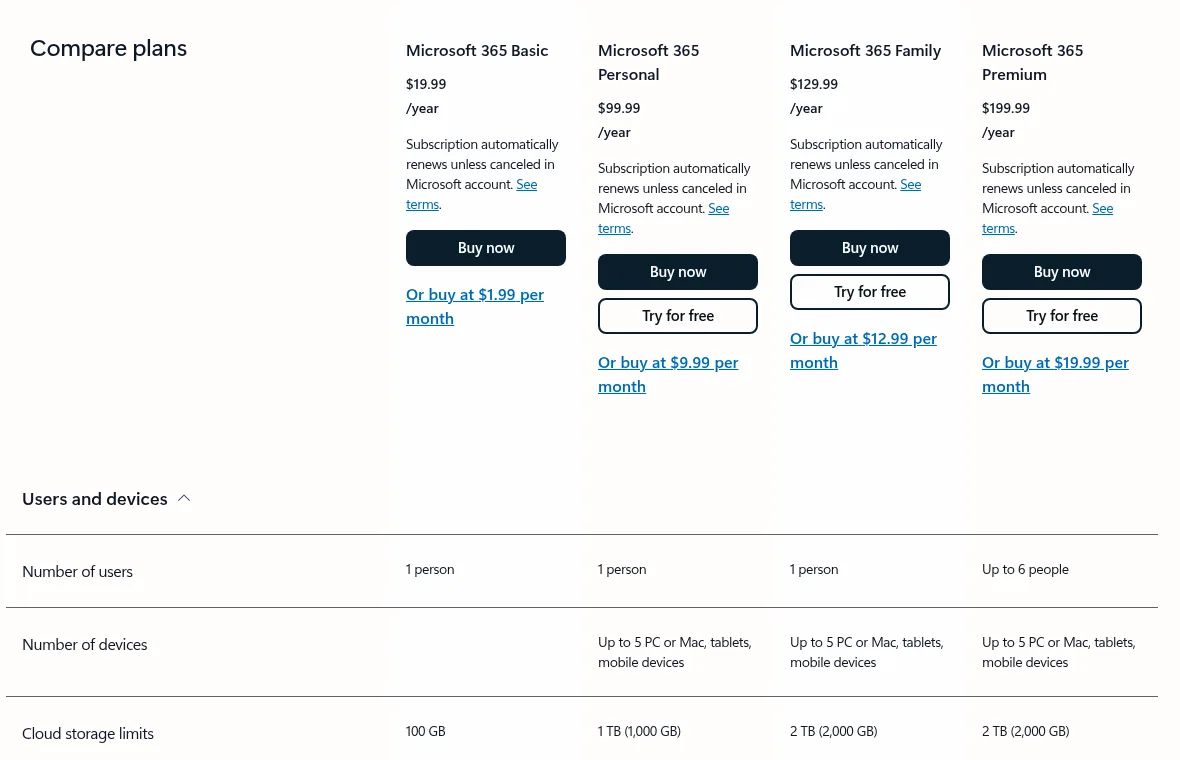
A Microsoft 365 Pro plan (5 TB shared) appears on Microsoft’s support pages but not on the US plans page, so it isn’t in the table. The AI features in Personal, Family, and Premium are available only to the subscription owner, not to people the plan is shared with.
What changed on October 8, 2026?
Storage change · October 8, 2026
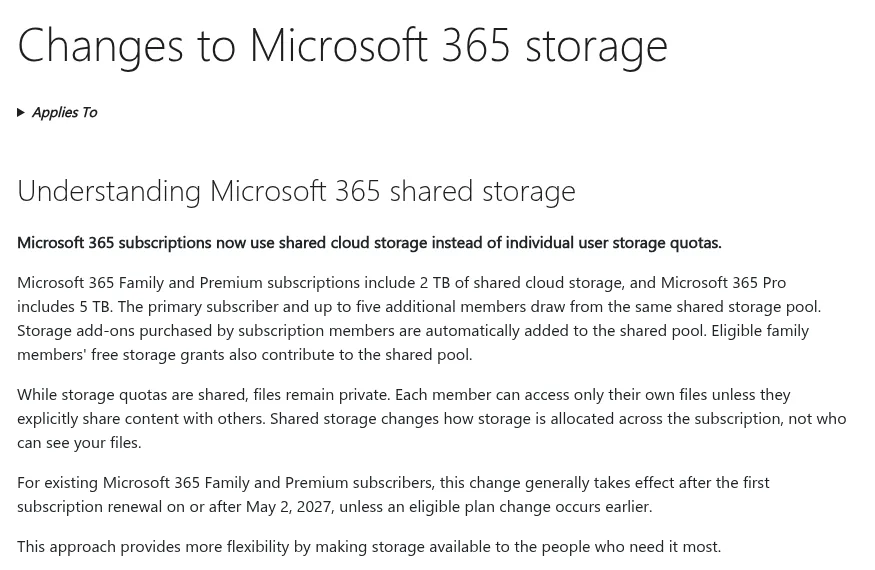
Microsoft 365 Family and Premium moved from 1 TB per person to 2 TB shared across the whole subscription. According to Microsoft’s notice:
- New and upgraded subscriptions get 2 TB of shared storage starting October 8, 2026, including expired subscriptions that are repurchased.
- Existing subscribers move to shared storage at their first renewal on or after May 2, 2027. Nothing changes before then, and Microsoft says it will email you before your renewal.
- Files stay private. Shared storage changes how space is allocated, not who can see your files.
- Up to six people (the owner plus five members) draw from one pool, and any add-on storage joins that pool, up to 10 TB in total.
- If your group is over 2 TB, you get notifications first and can keep accessing your files for up to a year while you sort out storage.
Is it a cut? For six heavy users, yes: the old model allowed up to 6 TB. A family using a few hundred gigabytes each may never notice, and one heavy user can now use the whole 2 TB. Microsoft says some existing subscribers may get bonus storage at the switch.
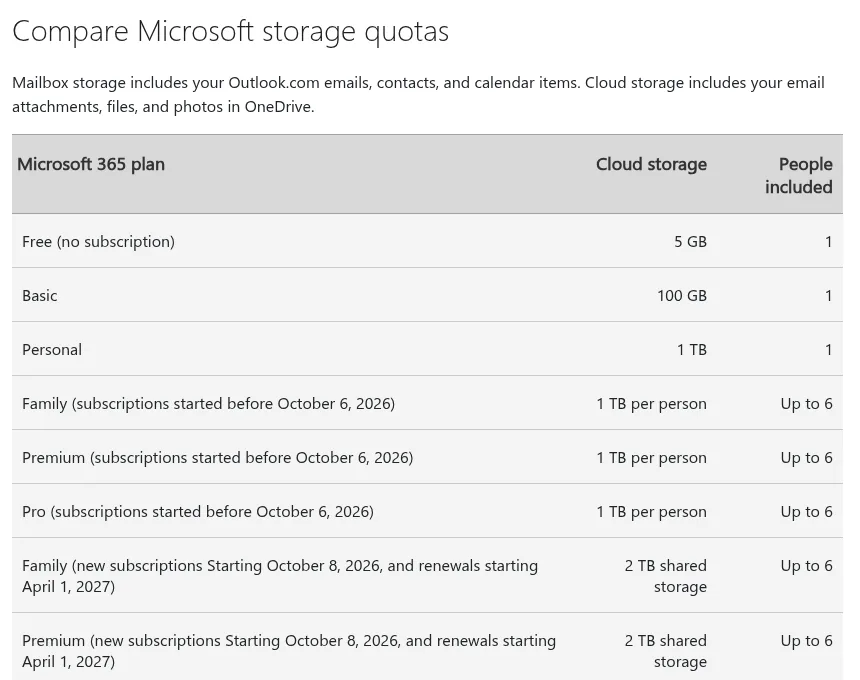
Microsoft’s pages didn’t all agree when we checked on October 11, 2026. The storage quotas page says existing subscriptions switch at renewals starting April 1, 2027, while the main notice and the storage FAQs say May 2, 2027, and some US plan cards still read “Up to 6 TB (1 TB per person).” We follow the dedicated notice and will update this page when the others match.
OneDrive for business teams
Businesses get OneDrive through Microsoft 365 business plans, each with 1 TB of OneDrive storage per user (Microsoft’s US business plans page). Prices went up on July 1, 2026 (Microsoft Licensing):
| Plan | Price (US) | OneDrive storage | Office apps |
|---|---|---|---|
| Microsoft 365 Business Basic | $7.00/user/month (was $6.00) | 1 TB per user | Web and mobile only |
| Microsoft 365 Business Standard | $14.00/user/month (was $12.50) | 1 TB per user | Desktop, web, and mobile |
| Microsoft 365 Business Premium | $22.00/user/month (unchanged) | 1 TB per user | Desktop, web, and mobile, plus device security |
Microsoft’s US business page also sells “with Copilot” bundles ($23.50 and $32.00 per user per month, paid yearly). It didn’t list a standalone OneDrive-only business plan, so we haven’t included one.
Is OneDrive safe and private?
OneDrive uses standard protections, and your account security matters as much as Microsoft’s. According to Microsoft’s security overview, files are encrypted in transit with TLS and at rest with a unique AES-256 key per file, and those keys are protected by master keys held in Azure Key Vault. Data is mirrored to at least two Azure regions. It doesn’t describe OneDrive as end-to-end or zero-knowledge encrypted, so if you need that, encrypt sensitive files yourself before you upload them.
Other protections Microsoft lists:
- Virus scanning of documents at download time with the Microsoft Defender engine.
- Suspicious sign-in monitoring, with email alerts for sign-ins from new devices or locations.
- Version history and a recycle bin for restoring earlier versions and deleted files.
- Ransomware detection and recovery for Microsoft 365 subscribers: you can restore files to a point before an attack, up to 30 days back.
Turn on two-step verification for your Microsoft account, keep sensitive documents in Personal Vault, and keep a second copy of anything you can’t afford to lose.
How does OneDrive compare with Google Drive?
They’re competing services, not the same thing: OneDrive is Microsoft’s, and Google Drive is Google’s. Google Drive gives you more free space, 15 GB shared across Gmail, Drive, and Google Photos (Google One Help), compared with OneDrive’s 5 GB shared with Outlook.com. OneDrive’s advantage is that it’s built into Windows 11 and File Explorer and works closely with Word, Excel, and PowerPoint.
| OneDrive | Google Drive | |
|---|---|---|
| Owner | Microsoft | |
| Free storage | 5 GB, shared with Outlook.com | 15 GB, shared with Gmail and Google Photos |
| Built into | Windows 11, File Explorer, Microsoft 365 | Gmail, Google Docs, Android |
| If you stay over quota | Frozen after 3 months; may be deleted after 6 | Content may be removed after 2 years |
Pick OneDrive if you’re on Windows and already use Office files or an Outlook.com address. Pick Google Drive if you live in Gmail and Google Docs, or you need the larger free tier. If you’re weighing a third option, our explainer on what Dropbox is and how it works and our Dropbox vs Google Drive comparison cover the alternatives. For the document side, see Google Docs vs Microsoft Word for teams.
Who should use OneDrive?
- Windows 11 users who want a hands-off backup. Folder backup and Files On-Demand are already on the PC.
- Microsoft 365 subscribers. You already pay for 1 TB or more, so using it costs nothing extra.
- Households on one plan. Family gives up to six people Office apps and, for new subscriptions, 2 TB of shared storage for $129.99 a year.
- Skip it if you already back up to another cloud service or an external drive and don’t need Office files. Unlink it so it doesn’t fill your 5 GB.
Pros (from Microsoft’s documentation)
What works: It’s built into Windows 11 and File Explorer. Files On-Demand saves disk space. 100 GB costs $1.99 a month. Paid plans add ransomware recovery and password-protected links, and Family covers up to six people.
Cons
The catch: The free 5 GB is small and shared with Outlook.com attachments. Going over quota stops email, and Microsoft may delete your files after six months over. Folder backup can move files people didn’t expect. Free Personal Vault holds only three files.
How we researched this guide
We read Microsoft’s US pricing pages and Microsoft Support documentation on October 11, 2026 (PKT) and linked each fact to its page. Our checks ran from a non-US connection; Microsoft’s en-us pages displayed US dollar prices. The three screenshots are real headless-Chrome captures of public Microsoft pages, taken while signed out. We didn’t install, test, or time OneDrive for this article, and we haven’t described anything as tested.
FAQ
No. OneDrive is Microsoft’s cloud storage service, and Google’s equivalent is Google Drive. They’re separate products from competing companies, though you can install both on the same PC or phone. Google Drive’s free tier is 15 GB shared with Gmail and Google Photos; OneDrive’s is 5 GB shared with Outlook.com.
It’s the web address for personal OneDrive accounts. Going to onedrive.com redirects there. If you’re signed in with a Microsoft account, you’ll see your files; if not, you’re sent to Microsoft’s OneDrive product page with a sign-in option. Work or school accounts use your organization’s own Microsoft 365 address instead.
Yes. OneDrive needs a Microsoft account, and Microsoft’s account help lets you sign up with an email address you already own; you only need a new Outlook.com address if you don’t have one or want one. Your Gmail inbox stays with Google. Microsoft may refuse addresses on work or school domains.
No. Pausing, unlinking, or uninstalling OneDrive stops syncing on that PC, but the files stored in your OneDrive stay online at onedrive.com. The catch is online-only files: they aren’t on your PC. Set them to Always keep on this device before unlinking if you want local copies.
OneDrive stops uploading, editing, and syncing new files, and Outlook.com stops sending and receiving email. Existing files become read-only. After three months over the limit your OneDrive is frozen, and after six months Microsoft might delete it. Free up space or buy a Microsoft 365 plan to fix it.
Only for existing subscribers, and only until their first renewal on or after May 2, 2027, per Microsoft’s main notice. New and upgraded Family and Premium subscriptions get 2 TB of storage shared by up to six people, starting October 8, 2026. Each member’s files stay private.
Sources
Every price and limit in this guide links to its source. All pages were checked on October 11, 2026 (PKT).
Show all 18 sources
- Microsoft Support: Microsoft storage FAQs
- Microsoft Support: Sync your computer’s files and folders with OneDrive
- Microsoft Support: How to create a new Microsoft account
- Microsoft News: Microsoft OneDrive launches worldwide (Feb 19, 2014)
- Microsoft Support: Save disk space with OneDrive Files On-Demand for Windows
- Microsoft Support: Back up your folders with OneDrive
- Microsoft Support: Automatically save photos and videos with OneDrive on iOS
- Microsoft Support: Automatically save photos and videos with OneDrive for Android
- Microsoft Support: How OneDrive safeguards your data in the cloud
- Microsoft Support: Protect your OneDrive files in Personal Vault
- Microsoft Support: Turn off, disable, or uninstall OneDrive
- Microsoft Support: How to pause and resume OneDrive sync
- Microsoft Support: Microsoft storage quotas
- Microsoft (US): Compare OneDrive plans (redirects to OneDrive plans and pricing)
- Microsoft Support: Changes to Microsoft 365 storage
- Microsoft (US): Compare all Microsoft 365 business plans
- Microsoft Licensing: Microsoft 365 pricing and packaging updates, effective July 1, 2026 (Feb 16, 2026)
- Google One Help: How your Google storage works
Changelog
- October 2026: Rebuilt as a plain-English explainer. Corrected the free tier to 5 GB (it was wrongly listed as 50 GB), replaced old prices with current Microsoft US prices, added the October 8, 2026 Family and Premium storage change, the July 1, 2026 business price changes, and steps to pause, unlink, or uninstall OneDrive. Removed unsourced user-count and uptime claims. Sources checked October 11, 2026; no hands-on testing was done.
- February 5, 2025: First published.
Related reads